The Definitive Guide for UK Site Managers
Working at height is a necessity for maintaining the UK’s infrastructure, from servicing HVAC units on city-centre offices to repairing historic stonework in Edinburgh. However, the question “When do I need fall protection?” is one that many site managers and building owners struggle to answer with certainty.
At Abseiling Services, we believe that clarity is the first step toward safety. Under UK law, the requirement for fall protection isn’t just about the height of the ladder; it’s about the presence of a risk.
In this guide, we will break down the legal triggers, the “Hierarchy of Control,” and the specific scenarios where you must implement certified fall protection systems.
Understanding the “Distance Liable to Cause Injury”
A common misconception in the industry is the “two-metre rule.” Historically, many believed fall protection was only mandatory if working above two metres. This is no longer the case.
The Work at Height Regulations 2005 removed specific height dimensions. Today, the law states that fall protection is required whenever there is a risk of a fall that could cause personal injury.
What does this mean in practice?
- If a worker is standing next to an opening in a floor, they need protection.
- If a worker is on a flat roof but near a fragile skylight, they need protection.
- If a worker is only 1.5 metres up but stands over sharp machinery, a shallow pit, or a liquid-filled vat, they need protection.
If a risk assessment identifies that a fall could result in injury, the law dictates that you must take action to prevent that fall.
How to Choose Your Protection
When you determine that fall protection is needed, the UK Health and Safety Executive (HSE) requires you to follow a specific “Hierarchy of Control.” You cannot simply jump to the most convenient method; you must choose the safest one in a specific order of priority.
Step 1: Avoidance
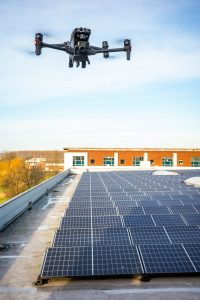
Can the work be done from the ground? For example, using long-reach poles for window cleaning or drones for initial roof inspections. If you can avoid working at height entirely, you must.
Step 2: Prevention (Collective)
If you must work at height, your first priority is “collective” prevention. This protects everyone in the area without them needing special training or individual Personal Protective Equipment (PPE). Examples include permanent guardrails, parapet walls, or scaffolds.
Step 3: Prevention (Personal)
If collective measures aren’t feasible, you move to “personal” prevention, commonly known as Fall Restraint. This involves a harness and a fixed-length lanyard that physically prevents the worker from reaching the roof edge or hazard.
Step 4: Mitigation (Collective)
If you cannot prevent a fall, you must minimise the distance and consequences of the fall. Examples include safety nets or soft landing systems installed beneath the work area.
Step 5: Mitigation (Personal)
The final resort is personal fall arrest systems. This involves an anchor point and an energy-absorbing lifeline that catches a worker mid-fall. While effective, this requires the most training and a robust rescue plan.
When Is Fall Protection Mandatory?
Rooftop Maintenance and Inspections
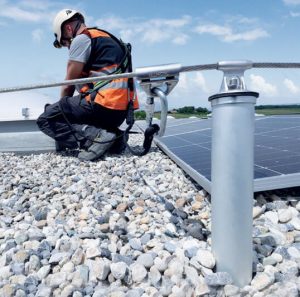
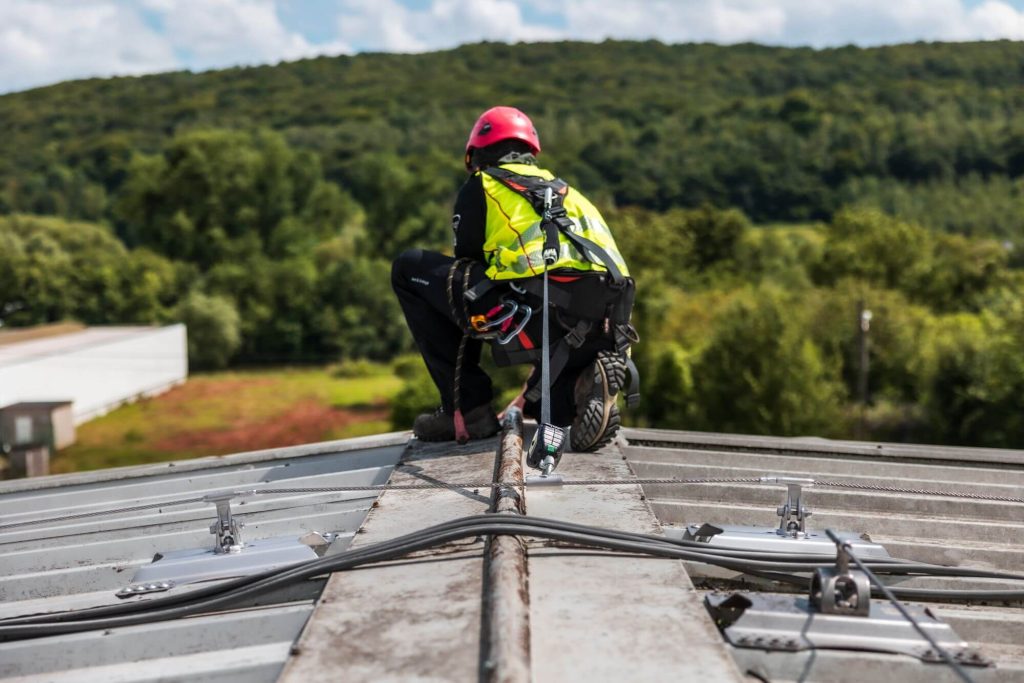
Whether it is a one-off repair or monthly maintenance of solar panels and plant equipment, rooftops are high-risk zones. You need protection any time a worker is within 2 metres of an unprotected edge or a “fragile” surface. A horizontal lifeline system or guardrails are the standard solutions here.
Vertical Access (Ladders and Pylons)
Fixed ladders on the sides of buildings or industrial chimneys pose a significant vertical risk. If a ladder is over a certain height or used frequently, a “hoop” cage is often insufficient by modern standards. A vertical fall arrest rail or cable system that stays attached to the climber’s harness is usually required.
Internal Voids and Atriums
Safety isn’t just an outdoor concern. Many modern UK offices and shopping centres feature large atriums or internal balconies. During the cleaning of internal glass, light bulb replacement, or painting near internal drops, fall protection is mandatory. Abseil anchor points or internal tracks for rope access are often the most discrete and effective solutions.
Fragile Surfaces
One of the most overlooked triggers for fall protection is the “fragile surface.” In the UK, many industrial units use fibre-cement sheets or roof lights that have degraded over time.
You need fall protection regardless of the height if the surface being walked upon cannot be guaranteed to support the weight of a person and their equipment. A fall through a roof is just as deadly as a fall off the edge of one. Often, these surfaces require designated walkways to spread the load and prevent a breakthrough.
Frequency of Access
The frequency of the task often dictates the type of fall protection you need. For high-frequency tasks, such as weekly plant checks, collective protection like guardrails is preferred because it requires no specialist training for the staff.
For medium-frequency tasks like monthly gutter cleaning, horizontal lifelines provide a secure and cost-effective balance. For low-frequency tasks, such as an annual structural survey, temporary anchors or specialist rope access (abseiling) may be the most efficient route.
Staying Compliant in the UK
If you have determined you need fall protection, it must be fit for purpose. In the UK, this means adhering to specific British Standards. If your equipment doesn’t meet these, it is not considered “adequate” protection under the law.
- BS EN 795: The standard for anchor devices.
- BS 8610: Specifically for anchor systems used for falls from height.
- BS 7883: The code of practice for the design, selection, installation, use, and maintenance of anchor devices.
At Abseiling Services, we ensure every system we install or inspect meets these rigorous criteria, protecting you from both physical accidents and legal liability.
The Dangers of Using the Wrong Protection
Sometimes, having the wrong fall protection is as dangerous as having none at all. A common error is using Fall Arrest in areas with low clearance. If a worker is only 4 metres above the ground, a fall arrest system with a long lanyard might not deploy in time to stop them from hitting the floor. In this case, Fall Restraint is the only safe option.
Another risk is the use of untested anchors. An anchor that hasn’t been pull-tested (as per BS EN 795) may pull out of the masonry under the force of a fall. The dynamic load of a human body falling is significantly higher than the static weight of the person.
Why Professional Inspection is Not Optional
UK law (specifically LOLER 1998 and BS EN 365) requires that fall protection systems are inspected by a “competent person” at least every 12 months.
You need an inspection if:
- It has been more than a year since the last check.
- The system has been used to arrest a fall (it must be decommissioned and checked immediately).
- The building has undergone structural changes.
- Extreme weather has potentially compromised the fixings.
How Abseiling Services Can Help
Determining exactly when and where you need fall protection can be a daunting task. Our team of height safety experts offers comprehensive site surveys to identify the “hidden” drop risks on your site.
We offer custom design, recommending the most unobtrusive and cost-effective systems, from SecuRope lifelines to SafeAccess rails. Our certified installation and statutory inspections provide the pull-testing and certification needed to keep your site operational and compliant.
Safety is a Choice, Not a Chance
When do you need fall protection? The moment a risk is identified. Whether you are managing a retail park in Glasgow, a residential block in Edinburgh, or an industrial site in the North of England, safety at height is paramount.
Don’t leave your staff’s safety or your company’s reputation to chance. By implementing certified, tested, and regularly maintained fall protection, you ensure that every worker returns home safely at the end of the day.
Are you unsure if your site meets current UK regulations? Contact Abseiling Services today. We provide expert consultations and certified height safety solutions across the UK. Let us take the “height” out of your safety concerns.